
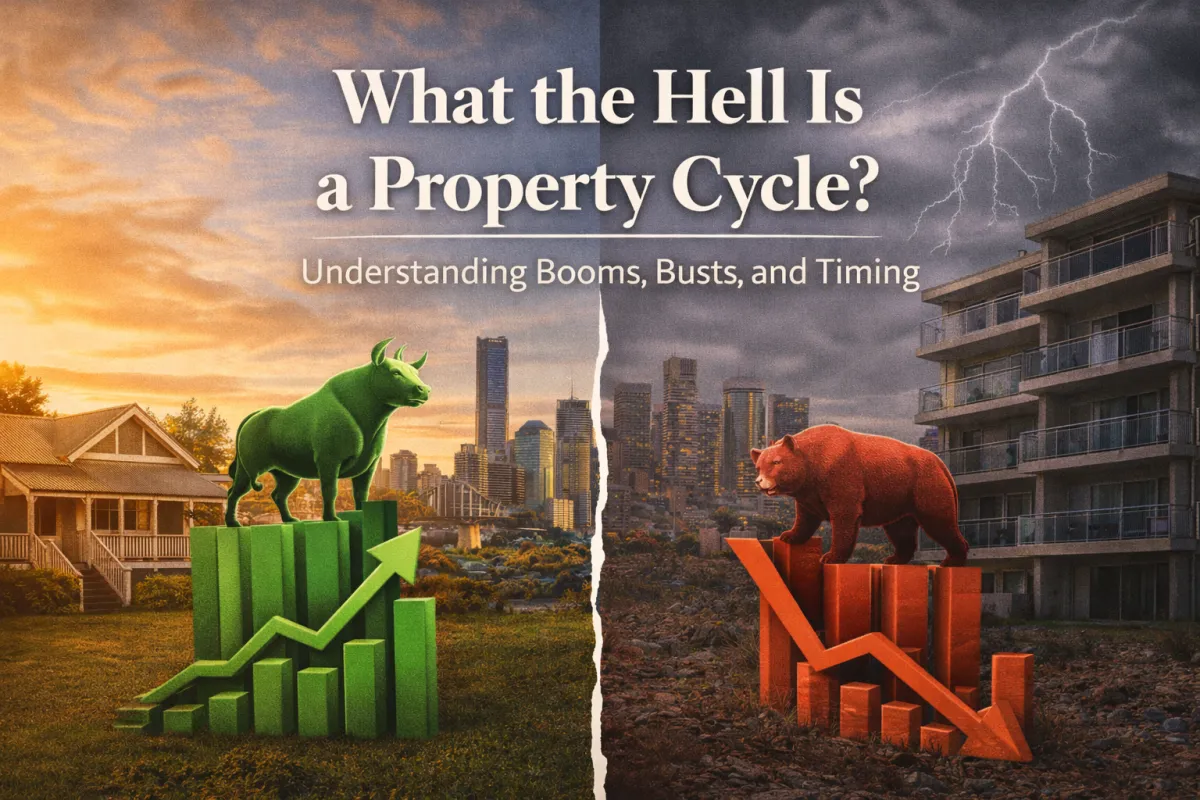
So What the Hell Is a Property Cycle Anyway?
Fair question. Let's start there.
A property cycle is basically the pattern that property markets move through over time—and here's what most people get wrong about this: they think it's completely random and unpredictable. It's not. There's actually a rhythm to it, and it averages out to around 18 and a half years. That pattern has repeated itself through history, across different countries, over and over again. Now, is it exact to the day? To the month? Sometimes not even to the year. But it's consistent enough that once you understand what to look for, you start seeing things most people completely miss.
The thing is, it doesn't play out exactly the same way in every country. Some markets have dramatic boom-and-bust cycles—really predictable highs and painful lows. Others, like Australia, tend to be softer, more managed. The cycle's still there, but the government steps in and smooths out the extremes. So you're not dealing with some mystical, unknowable force here. You're dealing with a pattern. And ignoring that pattern is like ignoring the weather forecast before you go camping. Sure, you might get lucky. But you also might end up soaking wet, wondering why the hell you didn't just check.
Do Cycles Even Actually Exist?
Yeah, they do. And honestly, you don't have to take my word for it—just look around. Everything moves in cycles. Seasons change—summer, winter, repeat. The tide goes in and out based on the moon. Your energy levels swing depending on whether you've had coffee or not (or maybe that's just me). The point is, across completely different systems—nature, culture, economics—there's a consistent pattern. Things don't move in straight lines. They move in cycles. Not perfectly, not predictably to the day, but consistently enough that ignoring it is genuinely risky. And property? It's no different.
Property Doesn't Exist in Its Own Little Bubble
Here's where most people get it wrong. They treat property like it's its own separate universe, like it just does its thing completely independent of everything else. Nope. Property sits downstream from everything: how much money's floating around in the system, what the government's doing (or not doing), whether people have jobs and feel secure, whether people feel confident or scared about the future, and what's happening globally. So if those things move in cycles—and they absolutely do—property's going to reflect that. Maybe not immediately, maybe not cleanly, but over time? Very clearly. It's like dominoes. One thing tips, and eventually it all flows through to property.
Follow the Money (This Is Where It Gets Real)
If you strip everything back to basics, property cycles are really about one thing: the flow of money. When money gets pushed into the system, banks start lending more easily, buyers suddenly have more capacity, confidence builds, and prices start climbing. And some of that money? It inevitably finds its way into land. Not because property's magic—but because it's where capital gets stored, leveraged, and competed for. People fight over it at auctions, they borrow against it, they park their wealth in it. When that flow of money slows down, lending tightens up, buyers hesitate, sentiment weakens, and the market shifts. You don't need a finance degree to see this play out. Just watch what governments do over time.
Watch What Governments Actually Do
Seriously, this is one of the easiest ways to see the cycle in action. One phase looks like this: government's spending money like crazy, infrastructure projects everywhere, stimulus packages flowing, everyone feels pretty good. Then eventually, someone mentions the word "debt," spending gets reined in, policy tightens, and things slow down. Then, after a while, the whole thing repeats. Different government, different language, same underlying pattern: expand, contract, repeat. And that flow of money doesn't just stay locked up in Canberra or treasury departments. It moves through the economy—into wages, spending, confidence—and eventually, it lands in property.
Why It Doesn't Always Look Obvious
Here's a common pushback: "If cycles are real, why didn't Australia crash like the US in 2008?" Great question. Because cycles aren't clean—they get influenced, they get distorted. In the US, credit collapsed overnight, liquidity dried up completely, people were forced to sell, and the whole thing spiraled. In Australia, pressure started building, but policy stepped in. Money got pumped back into the system—stimulus cheques, first home buyer grants, the works. The cycle didn't disappear. It was softened, smoothed out.
But let's be clear: Australia isn't immune to real downturns. If you're old enough to remember the early 1990s, you'll know what I'm talking about. Paul Keating famously called it "the recession we had to have," and it followed the same pattern you see everywhere: easy credit, rising asset prices, growing leverage—then a reset. People lost jobs, businesses went under, property prices fell. It was real. It was painful.
So what's different now? It's not that Australia avoids cycles. It's how they're handled. In more recent periods—particularly during the GFC—policymakers stepped in early. They cut rates, they supported the banks, they reopened the flow of money before a deeper unwind could take hold. That doesn't remove the cycle. It changes its expression.
In the US, excesses were allowed to unwind through falling prices and forced selling—the pain showed up in the asset prices themselves. In Australia, the response has more often been to stabilise demand and keep credit moving, softening the downturn and pushing pressure back into asset prices. The cycle is still there. The government just changes how the pain shows up. Sometimes that means prices don't fall as much—but it might also mean affordability gets stretched further, or debt levels stay elevated longer. Different outcome, same underlying cycle. It's like when you're about to fall off your bike but you manage to catch yourself at the last second. You didn't stop the wobble—you just didn't hit the pavement.
Why Timing Actually Matters (More Than You Think)
Alright, here's where this gets practical—and honestly, this is where people either build wealth or watch it slip through their fingers. Imagine two people—similar incomes, similar savings. They both buy properties around the same time, in similar areas, at similar prices. Fast forward ten years. One of them has built serious wealth. The other one's stuck, frustrated, wondering what the hell went wrong. What's the difference? Timing. Not perfect timing, not some magical crystal ball ability. Just an awareness of what kind of market they were stepping into.
One person bought when things were quiet, when there was room to negotiate, when the market wasn't running hot. The other bought when everyone was panicking about missing out, when competition was fierce, when prices were stretching. Same property type, different outcomes. And that difference? It compounds over time. It's the difference between feeling smart about your decision ten years later—or feeling like you got played.
The Problem With "Just Buy Something"
You've definitely heard this advice: "Time in the market beats timing the market." And look, there's truth to that. I'm not saying it's wrong. But it assumes a few really important things: you bought a quality asset, you didn't overextend yourself, and the market had enough room to absorb your mistakes. Early in a cycle, when things are quieter, those assumptions usually hold up fine.
But late in a cycle, when everyone's buying, when prices are stretching beyond what fundamentally makes sense, when people are borrowing up to their eyeballs just to "get in"—those assumptions start to break down. Competition gets emotional, people start paying stupid prices, debt levels creep up. The margin for error shrinks. That's when "just buy something" stops being helpful advice and starts being a gamble. It's like telling someone to jump off a diving board without checking if there's water in the pool first. Sure, there might be water. But wouldn't you rather know for sure?
Not All Property Moves the Same Way
Another massive mistake people make: thinking "the property market" is just one thing. It's not. There's property that tends to hold up well—scarce locations, owner-occupier driven, the kind of place people actually want to live in. Then there's the other stuff: generic apartments, oversupplied areas, investor-driven stock that swings wildly based on sentiment. That second type? It moves harder, both up and down. So when someone makes a blanket statement like "property always goes up" or "the market's crashing," they're probably missing the detail that actually matters. It's like saying "the weather's nice today" when it's sunny at the beach but pouring rain in the mountains. Context matters.
Two Types of Timing (And Why You Need to Think About Both)
Most people only think about timing in one way, and it's usually the wrong way. There are actually two types of timing you need to consider. Short-term timing (0–3 years): How competitive is the market right now? Are you buying into momentum or value? How much negotiation power do you actually have? This affects what you pay and the immediate risk you're taking on. If you're buying at the peak of a frenzy, you're probably paying too much. And that matters—because you're the one who has to live with that decision.
Long-term timing (10–20 years): Where are we in the broader cycle? Are you early, mid, or late? Are you riding growth—or just hoping it shows up to justify what you paid? This determines whether the market does the heavy lifting for you, or whether you're sitting there for years, crossing your fingers and hoping things turn around. Big difference. One path builds wealth. The other builds regret.
Opportunities Don't Disappear—They Just Change Shape
Here's some good news: there's no such thing as a "perfect" time to buy. Opportunities exist in every phase of the cycle—they just look different. Early cycle, markets are quiet, people are cautious, you can find overlooked value, there's room to negotiate. Mid cycle, growth is steady and predictable, it's easier to make decisions, things feel stable. Late cycle, it's competitive, expensive, requires real discipline and a clear head—margin for error is smaller. Downturn? Uncomfortable as hell, but often where the best opportunities sit, if you've got the guts and the cash.
The people who do well aren't the ones trying to time it perfectly. They're the ones who adjust to what's in front of them. They don't fight the market—they work with it. They understand that different conditions require different strategies. They're not paralyzed by fear, and they're not driven by greed. They're just paying attention.
Why Some People Build Wealth and Others Get Stuck
You've seen it happen. Some people build serious, life-changing wealth through property. Others—just as smart, just as hardworking, just as capable—get stuck, or worse, go backwards. What's the difference? Usually it comes down to a few key things: timing (what phase of the cycle they bought in), asset selection (what they actually bought), risk tolerance (how much they stretched themselves), and understanding (whether they knew what was happening around them—or ignored it).
And here's the kicker: at the very peak, when everyone feels confident, when prices are climbing fast, when it feels like you have to get in or you'll miss out forever—that's often when people take on the most risk. They borrow more than they should, they stretch further than makes sense, they assume things will keep going up. That's where problems start. It's like getting cocky right before you wipe out on a bike. You don't see it coming until you're already on the ground, wondering how you got there.
The Bigger Picture (What This All Actually Means)
So yes, cycles exist. And they're more predictable than most people think—averaging around that 18-and-a-half-year rhythm. But they're not presented in some simplified, neat little graph. They're messy, they're influenced by policy, sentiment, global events, and human behaviour. They're the result of money moving through the system, governments expanding and contracting policy, confidence building and fading, and human behavior repeating the same patterns over and over. Property is just one part of that larger system. And when you understand how that system works—even just the basics—you stop being at the mercy of it. You start making decisions with the market instead of against it. You stop feeling lost and start feeling in control.
The Real Takeaway (What You Should Actually Do With This)
This isn't about trying to perfectly time the market. Forget that—it's impossible. Anyone who tells you otherwise is either lying or delusional. This is about not walking into it blindly. Instead of asking "Is now a good time to buy?" start asking "What's actually happening right now—and what risks come with that?" Because timing doesn't just influence whether you should buy. It should influence what you buy.
Different points in the cycle favour different types of assets. In a hot, competitive market late in the cycle, you need to be pickier—quality matters more, scarcity matters more, you can't afford to buy rubbish and hope the market bails you out. In a softer, quieter market, you've got more room to move, you can find value others are overlooking, you can reposition something that needs work, there's more negotiation power.
And your budget? It interacts with all of this. What you can buy with $600k in one phase of the cycle might be completely different from what you can buy with $600k in another phase. That's where most people go wrong. They fixate on a number—"I've got $600k, what can I buy?"—instead of asking whether the asset available at that price, right now, in this market, actually makes sense. Because the goal isn't just to buy property. It's to buy something that still holds up when conditions inevitably change. You want something that doesn't need perfect conditions to work, something that makes sense even if the market flatlines for five years, something you won't regret when you look back on it.
A Simple Filter Before You Buy Anything
Before you sign on the dotted line, just run through these questions. Not emotionally—structurally. Be honest with yourself. Because this is your money, your future, and your peace of mind on the line.
What phase of the cycle does this feel like, and what risks come with that? Are you buying into a frenzy, or is it quiet? What does that mean for what you're about to pay?
Am I relying on continued growth to justify this purchase, or does it stand on its own? If the market flatlines for five years, does this still make sense, or are you banking on growth to bail you out?
Is this the best asset I can get for my budget right now, or just the easiest one to buy? Are you settling because you're tired of looking, or is this genuinely the best option available?
How would this property perform if conditions tightened or sentiment shifted? What happens if interest rates go up, if people stop buying in this area, if the market cools off?
Am I making this decision calmly, or am I reacting to pressure, competition, or fear of missing out? Be brutally honest here. Are you being rushed? Are you feeling pressured? Or are you genuinely comfortable with this decision?
If you can answer those clearly—without BS-ing yourself—you're not guessing. You're positioning. And that's the difference between building wealth and just hoping things work out. That's the difference between looking back in ten years feeling proud—or feeling like you got taken for a ride.

What Clients Value
Adelle Russell
Property Investor/ Renovator
Shane bid at an auction for us while we were overseas, but more than that, he’s helped us build a solid investment strategy. His advice has been key to understanding the market, and he’s great at making complex stuff easy to get.

John Muirhead
Property Investor
I’ve worked with Shane for several years, and his professionalism and real estate knowledge are outstanding. Managing a Sydney portfolio, I’ve had many successful projects with him, and our relationship remains highly professional. Whenever I invest, Shane is my first call—his honesty and integrity are second to none.
J Readshaw
ANZ
I’ve known Shane for over 30 years, and he’s always been someone you can count on. Laid-back, clever, and just great at making things happen. These days, he’s my first call for anything property-related — he’s helped me make some great moves. I trust him completely.

Better Call Shane is the educational platform of Bourdain Property Advisory.
For personalized property advisory services, visit Bourdain.com.au
Founded by Shane Mills | 30+ Years Experience | 2,000+ Projects
Contact


© Copyright 2025. BetterCallShane.com. All rights reserved.