
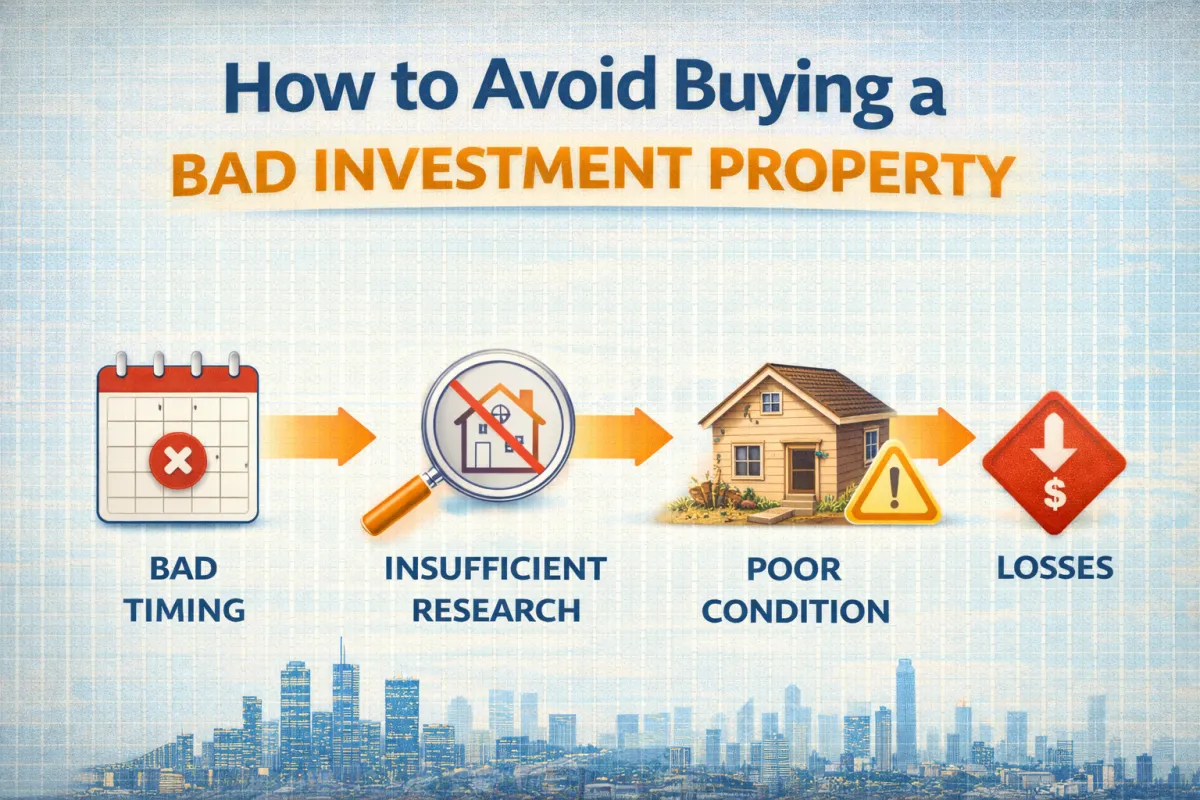
How to Avoid Buying a Bad Investment Property in Brisbane
Look, there are two main ways property investments go sideways.
You buy the wrong property.
Or you buy at the wrong time in the property cycle.
Either one will slow you down. But when both happen together? When someone buys the wrong property at the peak of the market?
That's when things get painful — financially and emotionally.
Here's what you need to understand:
Property markets move in cycles. Always have, always will. Strong growth periods are followed by slower growth, stagnation, or sometimes decline. This pattern repeats consistently throughout history.
When confidence is high and prices have already jumped significantly, more buyers pile in. And that's exactly when you see more lower-quality, investor-focused properties flooding the market. Risk goes up, but most buyers don't realize it until it's too late.
Now, I can't predict the future with perfect accuracy. Nobody can. But history shows clear patterns in how property markets behave — and understanding those patterns helps you avoid expensive mistakes.
Here's the good news:
Cycles don't just create risk. They create opportunity.
When markets soften, some owners who bought the wrong property at the wrong time need to sell. Sometimes by choice, sometimes not. This creates opportunities for informed buyers to pick up quality property under much better conditions.
That's just how cycles work. Excess gets corrected. The market resets.
For buyers who understand cycle dynamics and focus on fundamentally strong property, these correction periods can present some of the best long-term opportunities available.
In 2026, Brisbane has strong fundamentals — population growth, infrastructure investment, all the good stuff. But not all properties will perform equally. Selection matters. Timing matters.
Understanding how these two factors work together is how you avoid costly mistakes.
The Critical Distinction: Evergreen Property vs Investor Stock
Not all property is created equal — even on the same street.
One of the most important distinctions you need to understand is between Evergreen property and Investor Stock.
Evergreen property remains desirable across multiple property cycles.
It has characteristics that appeal strongly to owner-occupiers:
Boutique or smaller developments
Lower-density buildings
Desirable, established locations
Unique or scarce attributes
A higher proportion of owner-occupiers
These properties stay in consistent demand because people genuinely want to live in them. That demand supports long-term capital growth.
Investor Stock is designed primarily to attract investors, not owner-occupiers.
These properties often look fantastic on the surface. Professional marketing. Modern finishes. Great depreciation benefits. They look excellent on paper.
But they share characteristics that increase long-term risk:
Large, high-density developments
Many similar or identical units
Locations with significant ongoing supply
A higher proportion of investor ownership
In Brisbane, you see this distinction clearly in larger apartment developments in high-density areas like parts of the CBD, Portside, and Hamilton — places where significant volumes of new supply have been introduced over time.
Does this mean every apartment in these locations will underperform? No. But you need to carefully understand supply dynamics and long-term demand drivers.
Smaller boutique buildings, well-located units in established areas, and properties with genuine scarcity tend to be more resilient across different stages of the property cycle.
This distinction becomes especially important when combined with cycle timing.
Investor Stock purchased late in a strong growth phase — when supply is elevated and optimism is high — becomes vulnerable if market conditions soften.
Evergreen property tends to be more resilient because its demand is driven primarily by owner-occupiers rather than investors.
Not All New Developments Carry the Same Risk
Being a newer development doesn't automatically mean a property will underperform.
The key difference is whether the property has characteristics that create long-term, enduring demand.
Some developers focus on volume — producing large numbers of similar apartments designed primarily to meet investor demand.
Others focus on design, scarcity, and owner-occupier appeal.
In Brisbane, there are boutique developers like Graya whose projects tend to be more architecturally distinctive and produced in smaller numbers. Their buildings often have a unique character that differentiates them from larger, high-density developments.
Properties with distinctive design, limited supply, and strong owner-occupier appeal tend to be more resilient over time.
Historically, buildings that stand apart architecturally — rather than blending into large volumes of similar stock — remain desirable across multiple property cycles.
Think about architecturally significant buildings designed by figures like Harry Seidler. They've remained highly sought after decades after they were built.
The underlying principle isn't the developer name itself. It's the characteristics of the property.
Scarcity. Design quality. Owner-occupier appeal.
These factors support long-term demand.
Supply and Scarcity Drive Long-Term Performance
Property is governed by supply and demand. Pretty simple.
When supply is limited, prices get supported by competition.
When supply is abundant, price growth slows and becomes more vulnerable to changing conditions.
Properties that are difficult to replicate — because of their location, land content, design, or scarcity — perform more consistently over time.
Large volumes of similar properties create competition between sellers, which limits upward pressure on prices.
Scarcity supports long-term value.
Not All Locations Within a Suburb Perform Equally
Even within strong suburbs, performance varies significantly from street to street.
Factors that influence long-term demand:
Quiet streets versus busy roads
Flood risk
Proximity to transport and amenities
Surrounding land use
Future development potential nearby
Understanding these micro-level differences can have a significant impact on long-term outcomes.
Long-Term Thinking Is Essential
Property should always be viewed as a long-term investment.
Short-term market movements are far less important than long-term demand fundamentals.
Strong investment properties typically share common characteristics:
Limited supply
Strong owner-occupier appeal
Scarcity
Desirable location fundamentals
Alignment with long-term population and infrastructure growth
Avoiding poor property selection — particularly late in the property cycle — significantly reduces long-term risk.
Understanding both property selection and cycle timing helps you make more informed, lower-risk decisions.
Final Thoughts
Brisbane continues to benefit from strong long-term fundamentals — population growth, infrastructure investment, increasing national attention.
But not all properties will perform equally.
Understanding the difference between Evergreen property and Investor Stock — and how property cycles influence outcomes — is essential to avoiding costly mistakes.
Careful selection, combined with awareness of where we are in the broader cycle, can dramatically improve long-term outcomes.
For buyers who take the time to understand these principles, property remains one of the most effective long-term wealth-building assets available.
Professional Guidance
Many buyers seek professional guidance to help navigate market conditions and identify investment-grade opportunities.
If you would like professional assistance acquiring investment-grade property in Brisbane, you can learn more at:


What Clients Value
Adelle Russell
Property Investor/ Renovator
Shane bid at an auction for us while we were overseas, but more than that, he’s helped us build a solid investment strategy. His advice has been key to understanding the market, and he’s great at making complex stuff easy to get.

John Muirhead
Property Investor
I’ve worked with Shane for several years, and his professionalism and real estate knowledge are outstanding. Managing a Sydney portfolio, I’ve had many successful projects with him, and our relationship remains highly professional. Whenever I invest, Shane is my first call—his honesty and integrity are second to none.
J Readshaw
ANZ
I’ve known Shane for over 30 years, and he’s always been someone you can count on. Laid-back, clever, and just great at making things happen. These days, he’s my first call for anything property-related — he’s helped me make some great moves. I trust him completely.

Better Call Shane is the educational platform of Bourdain Property Advisory.
For personalized property advisory services, visit Bourdain.com.au
Founded by Shane Mills | 30+ Years Experience | 2,000+ Projects
Contact


© Copyright 2025. BetterCallShane.com. All rights reserved.