
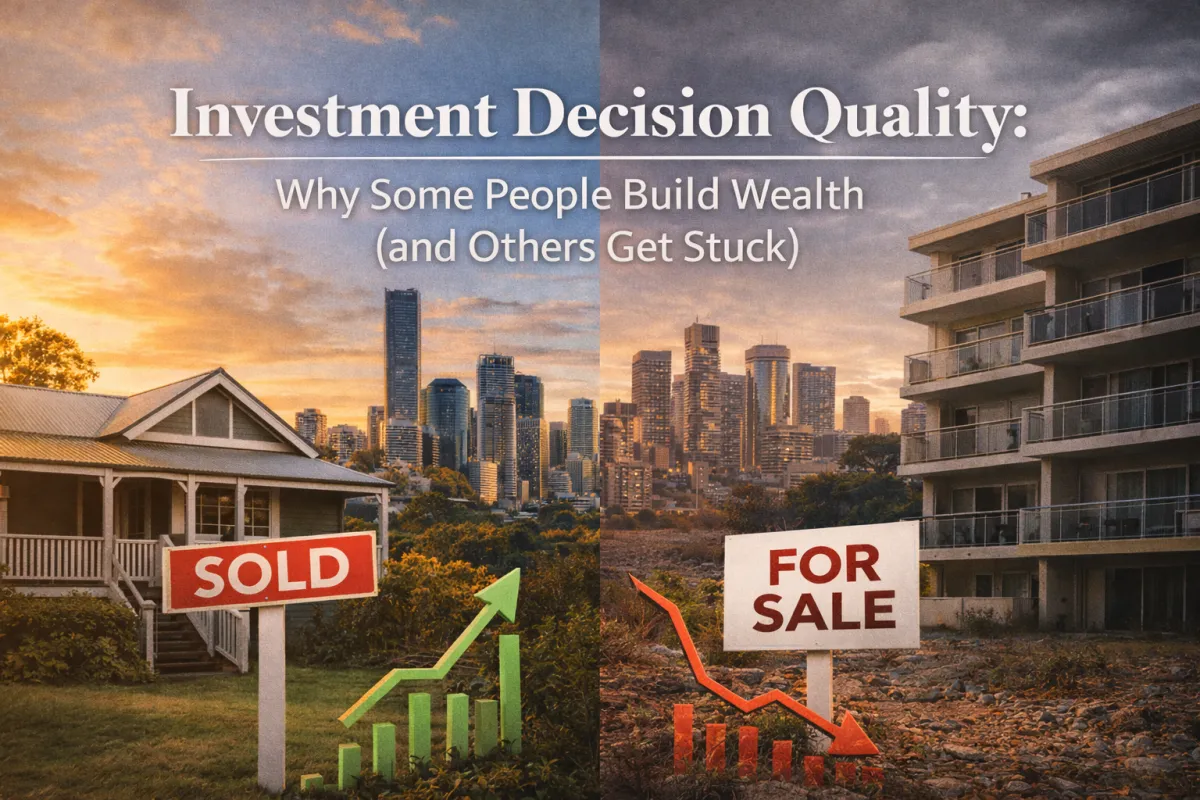
Investment Decision Quality: Why Some People Build Wealth (and Others Get Stuck)
Most people judge an investment the wrong way. If it goes up → good decision. If it goes sideways or down → bad decision. It sounds logical. It's also flawed. Because outcome and decision quality are not the same thing. And in property, that misunderstanding is where a lot of people get hurt.
A Rising Market Makes Everyone Look Smart
You see it every cycle. When markets are moving, people make decisions that feel justified in the moment. They stretch a bit. Compromise on quality. Pay more than they planned. And if the market keeps rising? It all looks like a good call. But it wasn't necessarily a good decision. The market just covered it.
Look, I'm not saying the market's about to crash. I'm not predicting doom. That's not the point. The point is this: when things are moving, it's easy to confuse a good market with a good decision. And right now? Things are moving. People are buying. Prices are rising in a lot of areas. There's energy in the market. Which is great—but it's also when mistakes get made. Not because people are reckless. But because when everyone around you is making money, it's hard to ask the harder questions.
When It Turns, It Doesn't Feel Obvious at First
Take the Gold Coast. Leading into the mid-2000s, it was everywhere. People were buying apartments because it was in the news, prices were rising, and other people were making money. It became what people like to call a "hot spot"—a term that usually shows up right when risk is building. At the time, it all felt justified. Then the cycle turned. Not in a single moment—but over time. Prices corrected and stayed under pressure for several years.
What Actually Happens in Oversupplied Markets
Picture a building with 100 apartments. Everything works while conditions are strong. But when things shift, rents soften, holding costs increase, and some investors start to feel pressure. If one owner sells, it's manageable. If ten need to sell? Now buyers have options. And if a few owners—especially those who need to liquidate quickly—start discounting? That's when it happens. Prices don't just fall. They drift... then weaken... then compete lower. That's how markets behave when supply is high and pressure builds.
A Slower Version of the Same Problem
Now look at parts of Melbourne—Docklands is a common example. Plenty of apartments. Plenty of supply. People bought expecting growth. What many experienced instead was long periods of flat or underwhelming growth, ongoing holding costs, and limited upside relative to expectations. That's a different type of risk. Not a sharp correction—but a slow one. And over time, that can be just as costly, because while the asset goes nowhere, your money is tied up, your flexibility is reduced, and other opportunities pass you by.
The question isn't just "will this grow?" It's "will I be okay if it doesn't?" Can you carry this until things pick up again? Because that's something most people don't think about until they're already stuck.
This Is Where Decision Quality Shows Up
At the time those purchases were made, they didn't feel reckless. They felt reasonable. That's the point. Weak decisions rarely feel weak in the moment. They feel justified. They feel supported by what everyone else is doing. They feel like the market will carry them.
The Same Asset Can Produce Opposite Outcomes
Now flip it. Same type of asset. Different timing. There was an example in Brisbane where one buyer paid around $600,000, sold a few years later closer to $400,000. A poor outcome. But that same property later sold again for around $650,000. So first buyer loses significantly, second buyer makes strong gains in a shorter period. Same asset. Different timing. Different decision.
That's Why Blanket Statements Don't Work
You'll hear things like "apartments don't grow" or "never buy units." It's too simplistic. We've seen people make very good money on apartments. We've also seen people get stuck in them. The difference isn't just the asset. It's when it was bought, why it was bought, and what assumptions were made at the time.
Investment Decision Quality Isn't Simple
There's a lot going on underneath a good decision. It's not just price, yield, or location. It's questions like: Are we buying the right asset for this point in the cycle? Is there oversupply risk? Who is the likely buyer in the future? Are we relying on growth to make this work? Is there potential to add value—or are we just hoping? It's layered. And for most people, it's not immediately obvious.
A Better Way to Think About It
Instead of asking "will this make money?" a better question is: "does this decision make sense even if conditions aren't favourable?" Because good decisions don't rely on best-case scenarios. They hold up under pressure.
Where Opportunity Actually Comes From
Opportunity isn't random. It tends to show up where supply is constrained, demand is improving, or change is happening early. Take a simple example—an area with 600sqm blocks, older post-war homes, and early signs of gentrification. You start seeing renovations, knockdown rebuilds, and changing demographics. That's not hype. That's a shift. Now you've got options: hold and benefit from increasing scarcity, add value yourself, or position ahead of broader demand. That's a different type of decision.
Experience Changes What You See
When you're in the market every day, something shifts. You start to recognise value quickly, spot compromised stock immediately, and understand why something is priced the way it is. You'll walk through one property and think, "that's a good asset," then walk through another and think, "why did someone pay that for this?" That's not luck. That's pattern recognition built over time.
And Sometimes, Opportunity Comes From Pressure
This part isn't talked about much, but it's real. Sometimes the best opportunities come from someone needing to sell, pressure building in a segment, or situations where others are forced to exit. It's not comfortable. But it exists. And it's part of how markets reset.
The Reality
Investment decision quality isn't simple. It's not something most people grasp immediately. At first, it feels unclear. Then gradually, patterns start to emerge. And once they do—you start seeing the market differently.
The Takeaway
You can't control the market. But you can control how you enter it. The goal isn't to chase the best outcome. It's to make decisions that are thought through, defensible, and aligned with reality—not hope. Because if the decision is sound, the outcome has a much better chance of following. And if it isn't... the market will eventually expose it.
If you read this and feel like there's more to it than you first thought—that's normal. There is. And that's exactly why most people get it wrong.
Hey, if you feel like you need some help head over to www.Bourdain.com.au and request a chat. We'll talk about your situation and hopefully I can give you some pointers to get you going in the right direction.

What Clients Value
Adelle Russell
Property Investor/ Renovator
Shane bid at an auction for us while we were overseas, but more than that, he’s helped us build a solid investment strategy. His advice has been key to understanding the market, and he’s great at making complex stuff easy to get.

John Muirhead
Property Investor
I’ve worked with Shane for several years, and his professionalism and real estate knowledge are outstanding. Managing a Sydney portfolio, I’ve had many successful projects with him, and our relationship remains highly professional. Whenever I invest, Shane is my first call—his honesty and integrity are second to none.
J Readshaw
ANZ
I’ve known Shane for over 30 years, and he’s always been someone you can count on. Laid-back, clever, and just great at making things happen. These days, he’s my first call for anything property-related — he’s helped me make some great moves. I trust him completely.

Better Call Shane is the educational platform of Bourdain Property Advisory.
For personalized property advisory services, visit Bourdain.com.au
Founded by Shane Mills | 30+ Years Experience | 2,000+ Projects
Contact


© Copyright 2025. BetterCallShane.com. All rights reserved.